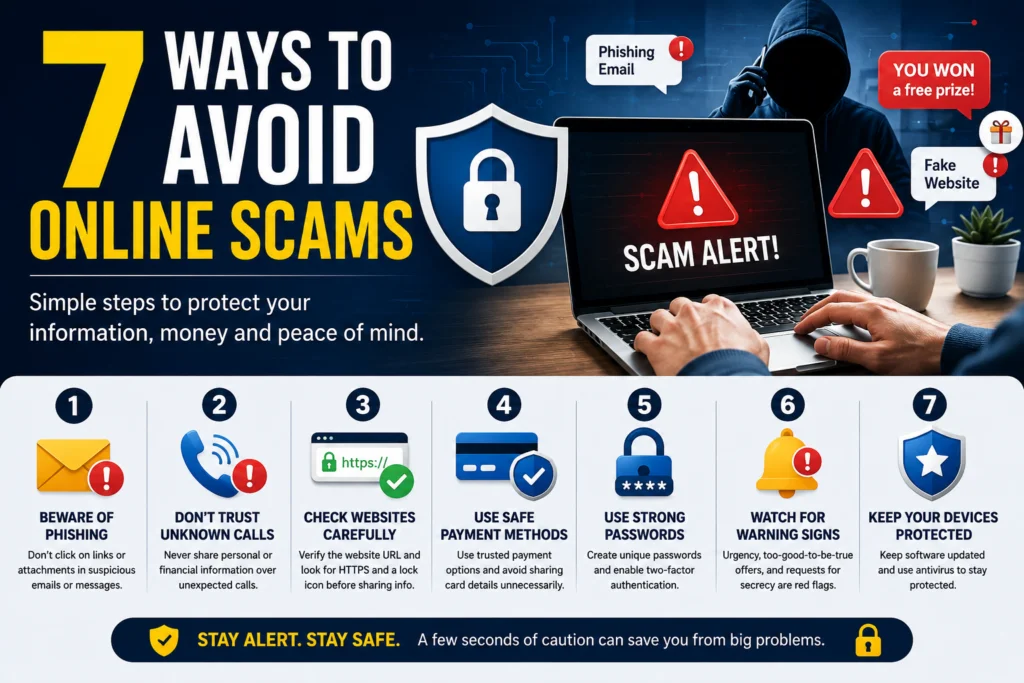
Introduction
Unfortunately, online scams are becoming increasingly popular as more and more people use the Internet for communication, shopping, banking, socializing, and other daily activities. Scammers use various methods in order to convince people to provide their personal information, money, or access to their online accounts so that the fraudsters can steal their data, finances, or take over social media accounts. Online fraudsters can use fake social media accounts, misleading phone calls, fake websites, spam messages, and emails in order to lure naïve users into their traps.
There are essential ways to protect oneself against online scam artists. The most important step is to understand how to behave when a suspicious message, phone call, or text appears. In many cases, con artists use scare tactics and deception in order to convince people that it is necessary to share personal information or send them money. In addition, fraudsters use enticing offers and text the victim in order to lure them into a trap.
Therefore, it is critical to carefully check every doubtful message, since minutes spent on the right course of action can save hours and even years of problems with fraudsters.
Moreover, it is crucial to use strong passwords to all online services, check whether a website is legitimate before entering personal information, turn on two-step authentication when available, and stay cautious about what information to share on the Internet. Lastly, if a suspicious message cannot be identified as legitimate, it is safer not to click on it or install the file that was sent. In this article, you will find answers to all questions concerning how to protect oneself from online scammers and what to do if you suspect that fraudsters are trying to lure you into their trap.
Phishing
Phishing is one of the most common types of cybercrime that uses deception to trick individuals into disclosing personal information. Criminals use phishing emails, social media, phone calls, and fake websites to communicate with the victims. In most cases, phishing emails come from fraudulent accounts that pretend to represent a particular company, bank, or organization. Scammers impersonate customer care executives, delivery services, government agencies, online retailers, and other trusted entities. The criminals target specific information such as passwords, account login details, credit card passwords, and verification codes.
The phishing process often begins with a spam email, a phone call, or a text message that compels the recipient to click on a link or call a particular phone number. For instance, the scammer may claim that the targeted individual has an outstanding payment, their account has been suspended, or they need to verify certain information urgently. The link provided in the email or text message directs the victim to a fake website that requires them to provide the necessary details. Once the unsuspecting individual enters their information, it is relayed to the scammer.
The best way to avoid falling victim to phishing is by avoiding spam emails and text messages. One should also be wary of emails and text messages with typos, misspellings, or grammar mistakes. In case of doubt, it is advisable to contact the company or organization mentioned in the spam email or message to confirm their authenticity. A legitimate company will always give the contact information on its official website, social media accounts, or email addresses.
Using strong and unique passwords for different accounts and activating two-factor authentication whenever possible will protect personal information if the phishing attempt is successful. Most importantly, one should never provide personal information when requested. It is essential to take time to verify any request for sensitive information to ensure it is not a phishing attempt.
Fake Calls
Another popular cybercrime involves fake calls during which scammers pose as representatives of banks, shops, government institutions or other organizations and try to convince people to disclose their passwords, card numbers, PIN codes or other personal information. Fake callers often attempt to scare people or give them an incentive to provide the required information quickly.
One should know that any legitimate company can ask to check the status of an account or verify any personal details. However, one should never share the personal information that requires any kind of verification, especially in case where a caller asks to do it right away. In addition, a scammer may ask to install a program or allow them to access the computer or a phone to install malicious software that allows criminals to steal money or store personal data. It is better to be safe than sorry, so it is important to remember some basic safety measures when receiving a suspicious call.
Any request from an unexpected caller to provide passwords, one-time codes, or other personal data should be denied. Additionally, one should never call back if a phone number provided by a caller does not coincide with the number on the bank’s or any other official website. One should always check official channels, such as the customer service number provided on the bank’s website or contact the organization directly instead of calling back the number provided by the caller.
If a scammer tries to intimidate or force a person to provide access to personal data or accounts, one should not become stressed and suspicious. Remember that every threat can be a manipulation technique, and any account closure or other negative outcome would happen only if a person gives access to personal information.
Fake Websites
Fake websites are created to appear legitimate, in order to steal personal information, such as credit card payments, usernames, passwords, or other sensitive data. These websites may be created to look like a shopping page, a bank, a social media website, a government organization site, or any other website with valuable information. In addition, scam artists may advertise fake websites via email, text message, search engine results, social media, or other methods.
One way to avoid fake websites is to check the web address. Scam websites may have web addresses that appear similar to legitimate websites, but with a few additional characters or letters. Fake websites may also have misspelled words, incorrect links or pop-ups, or advertisements for fake products or services. On the other hand, a legitimate looking website should not automatically be trusted, since scam artists are often able to copy details of legitimate websites with great accuracy.
As an additional precaution, it is recommended to double check the website address, in order to ensure that a legitimate website is opened. This can be done by manually typing the website’s address in the address bar of a browser, or by using a specific application for the website, if available. In addition, it is best to avoid entering personal information or making payments on suspicious websites. One should only enter personal information on secure websites and use safe payment methods, such as credit cards or debit cards.
Another tip is to ensure that the browser is up to date, as it may have protective features that warn the user if a suspicious website is opened. It is advised to avoid fake websites, as well as other suspicious online resources. If an official website requires the download of an application, file or software, it should be double checked, since scam websites may imitate this procedure to steal personal information, such as financial data.
Safe Payments
Although making payments online is a relatively easy and quick process, it is essential to keep in mind that there are some safety measures to ensure that your money is not stolen by fraudsters.
Firstly,
make sure that you are making the payments on an official website, app, or payment system
Never enter any personal or card information on suspicious websites and links that may come to your phone or email. Double-check the website’s address when shopping online and only use the trusted payment systems that have all the security checks and, preferably, leave you with a transaction confirmation receipt. Moreover, it is essential never to give up your PIN, password, or any other verification codes to anyone. The bank, in most cases, will never contact you and ask for your codes; therefore, if someone calls you, do not provide the information right away. It is also worth turning on the notifications from the bank to get a confirmation of each transaction.
Checking the withdrawal history on the bank’s official website or application periodically can also help prevent any unwanted withdrawals or payments.
When in an unstable network, it is better not to make any payments online and only use trusted websites or networks. Keeping the phone’s system up to date and having updated antivirus programs can also contribute to keeping the phone or computer safe from hackers.
Lastly,
if you are being pursued to pay some sum of money, and the conditions seem too good to be true, there is a possibility that you are dealing with fraudsters. Therefore, it is essential to double-check any information you are given and only work with the trusted organizations and persons.
Warning Signs
The ability to recognize the warning signs of an online scam will allow you to protect yourself from financial loss and the theft of your personal information. First and foremost, any unexpected phone call, message, or e-mail requesting your personal information, passwords, banking details, or verification codes needs to raise your suspicion. Often fraudsters use the identity of organizations to gain access to your information by making them believe that they are communicating with a trusted company.
Furthermore, be highly wary of any communication suggesting urgency or pressure to make a fast decision. A scammer will induce fear of loss of services, goods, or opportunities to keep you from double-checking whether the message is fake or not. Another hint indicating potential online fraud is too-good-to-be-true offers. Be especially cautious with unsolicited advertising, prizes, rebates, profits, or any other benefits that require your intervention to receive the reward. Lastly, scammer often use poorly constructed web pages with incorrect addresses, links, brand logos, and other apparent inconsistencies.
Thus, any unexpected request for disclosing your personal information, using unsecure ways of payments, or keeping the transaction secret should be classified as a potential fraud. Furthermore, never provide verification codes, passwords, and other confidential information to an unexpected caller. Additionally, if you suspect any online fraud, take the time to double-check the message. The extra effort may save you from financial loss and inconvenience.
You might also be interested in reading:
Best Free Antivirus Software in 2026
Best Password Managers: 7 Top Picks
9 Ways to Secure Your Google Account
8 Best Free VPN Services to Try in 2026
How to Remove Viruses from Windows: 7 Easy Fixes
Conclusion
In order to protect yourself from becoming a victim of online fraud, you need to be knowledgeable and careful as well as have a good set of cybersecurity measures. There are various types of scam methods, which may involve phishing emails, fake calls, websites, and even payments. Understanding the nature of each scam method will allow you to easily spot a threat.
Never respond to strange emails or calls, which request to share passwords, bank information, confirmation codes or pay money. Always verify the sender’s identity by checking their contact details on a trustworthy website or application prior to clicking any links or providing private data. Use only secure payment methods when purchasing goods online.
There are certain things that indicate that an offer may be a scam, and you should definitely be aware of them. These include urgency, an unbelievably beneficial offer, an unfamiliar website address, a strange method of payment and request for confidentiality